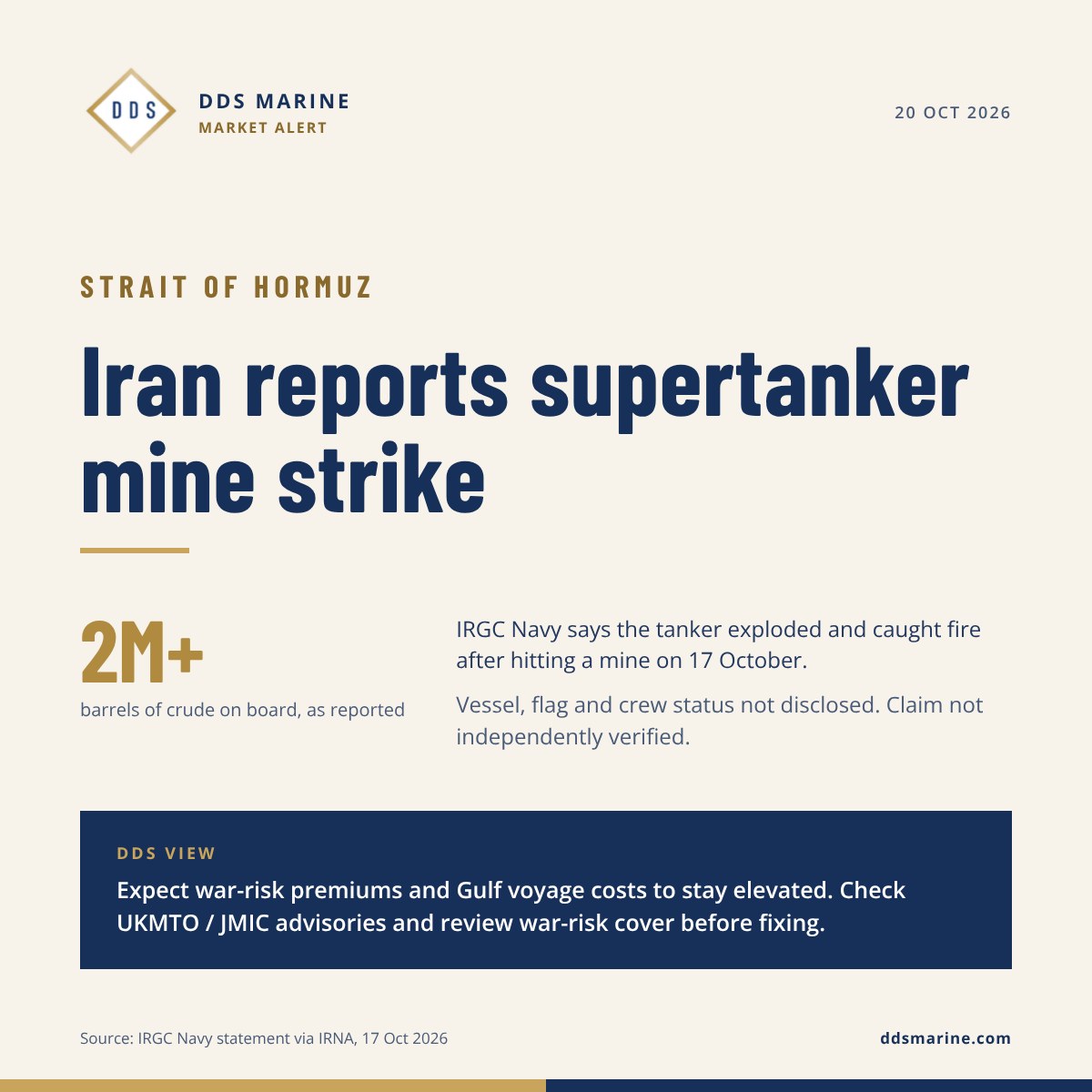
Iran's Islamic Revolutionary Guard Corps (IRGC) Navy said on 17 October 2026 that a supertanker carrying more than two million barrels of crude oil exploded and caught fire after striking a naval mine in the Strait of Hormuz. It is the latest in a run of mine incidents the IRGC has reported this month, and it adds to the risk picture for every owner, charterer and operator with exposure to Gulf liftings.
What was reported
According to the IRGC statement, carried by Iranian state media including IRNA and Tasnim, the tanker was attempting to transit the strait on a route Iran has not authorised. The IRGC said the vessel had switched off its positioning and radar systems to avoid detection, and claimed it was operating with US military support. Some reports of the statement say the blast hit the engine room and left the tanker without propulsion.
The IRGC did not name the vessel or give its flag, ownership, crew status or exact position. Images released alongside the statement have not been independently verified, and at the time of writing no owner, flag state or maritime security centre has publicly confirmed the incident.
Part of a wider pattern this month
The 17 October claim follows several similar statements in quick succession:
- 12 October: the IRGC said a supertanker of around two million barrels' capacity hit a mine with its navigation systems switched off, describing it as the third vessel to strike mines on the "prohibited route" in a matter of days.
- 14 October: the IRGC said a container ship sank after hitting a mine. Separately, UKMTO received a report of a container ship struck by an unidentified projectile near the exit of the strait.
- 17 October: some outlets reported the latest tanker as the second such incident within hours.
These incidents sit against months of disruption. Iran announced in July that it had again closed the strait, and while US Central Command said in late August that shipping lanes had reopened after mine clearance, Iran has continued to insist that vessels follow its own routing rules. Analysts at the Institute for the Study of War have also suggested that vessels conducting ship-to-ship transfers in and around the strait may be a particular focus.
What remains unclear
Every detail of the 17 October incident currently rests on a single source: the IRGC itself. Without a vessel name, IMO number or independent imagery, it is not yet possible to confirm the scale of damage, the condition of the crew, or whether any cargo has been released. DDS Marine will update its assessment as flag states, owners, UKMTO or the Joint Maritime Information Center (JMIC) publish further information.
DDS view: what it means for the market
War-risk costs are likely to stay high. Repeated reports of mine strikes, verified or not, tend to keep additional war-risk premiums for Gulf calls elevated and can narrow the pool of owners willing to fix for Arabian Gulf loadings.
Dark transits carry new risk. The IRGC has repeatedly linked these incidents to vessels sailing with AIS switched off. Owners should weigh that carefully against their own security advice, since the practice may draw scrutiny from more than one direction.
Knock-on effects reach Asia. Much of the crude moving through Hormuz is bound for Asian refiners. Disruption at the strait can lengthen voyages, shift cargo flows and increase demand for storage and ship-to-ship capacity in hubs along the Straits of Malacca and Singapore. Operators in our region should plan for that volatility.
Practical steps for owners and charterers
- Follow the latest UKMTO and JMIC advisories before and during any Gulf transit.
- Review war-risk cover, listed-area status and additional premium terms with brokers and underwriters before fixing.
- Check charter party war-risk and Hormuz-specific clauses, including rights to refuse orders and how added costs are allocated.
- Brief masters and crews on mine awareness, reporting lines and emergency procedures.
- Build realistic schedule buffers for Asia-bound cargoes, including possible delays at loading and transfer points.
Outlook
Until the facts of the latest incident are independently confirmed, the market is likely to keep pricing in risk rather than waiting for certainty. DDS Marine continues to monitor developments in the Strait of Hormuz and their effect on tanker operations across Southeast Asia, and covers them each week in the DDS Weekly Maritime Intelligence. For operational support with STS transfers, chartering or marine assurance, contact our team.
Sources: IRGC Navy statement as reported by Bernama/IRNA, RFE/RL and Shafaq News; earlier incidents from Bernama/Anadolu and Ahram Online. Details have not been independently verified.